
The concept of degree days plays a crucial role in energy management, particularly in relation to heating and cooling requirements of buildings. By quantifying how outdoor temperature deviates from a baseline (or comfort zone), degree days provide a practical method for estimating energy consumption, controlling building systems, and optimising efficiency.
WHAT ARE DEGREE DAYS?
Degree days are a simplified measure of temperature-driven energy demand. The main idea is to calculate how much the daily average temperature deviates from a reference temperature, called the base temperature. When it comes to building management, this base temperature typically represents the temperature above or below which heating or cooling systems are needed.
There are two primary types of degree days:
- Heating Degree Days (HDD): Used to estimate the demand for energy needed to heat a building. The more HDD, the colder it has been and the higher the heating requirements.
- Cooling Degree Days (CDD): Used to estimate the energy needed for cooling. The more CDD, the hotter the temperature and the greater the cooling requirement.

THE CALCULATION OF DEGREE DAYS
Degree days are calculated by comparing the outdoor temperature to a pre-set baseline or base temperature. For most cities, the base temperature is around 18°C. The calculation of degree days can be performed on a daily, monthly, or annual basis depending on the desired resolution.
FORMULA:
- For Heating Degree Days (HDD):
If the average outdoor temperature is below the base temperature:
HDD = Base Temperature (18°C)−Average Temperature ({max + min} / 2) - For Cooling Degree Days (CDD):
If the average outdoor temperature is above the base temperature:
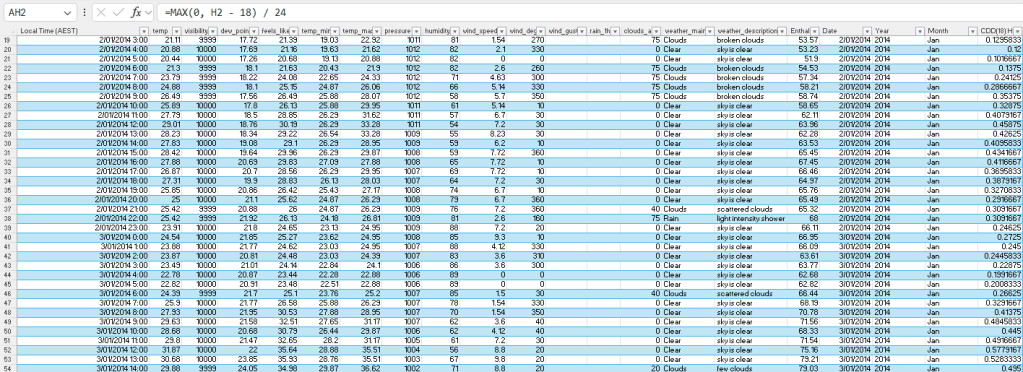
CDD = Average Temperature ({max + min} / 2) − Base Temperature (18°C)
THE IMPORTANCE OF DEGREE DAYS IN ENERGY MANAGEMENT
Degree days are widely used for forecasting and monitoring energy usage in buildings. They enable facilities managers, HVAC engineers, and energy auditors to make informed decisions about building performance, identify areas of inefficiency, and fine-tune HVAC systems. Degree days are especially valuable for large building portfolios where consistent data is essential for benchmarking and optimising energy use.
KEY USES:
- Energy Consumption Forecasting: By understanding the historical relationship between degree days and energy usage, facility managers can forecast future energy demand, which helps in planning and budgeting.
- System Optimisation: Degree days help HVAC operators fine-tune systems to meet the exact heating and cooling demands without excessive energy consumption. Adjustments can be made to the system’s control strategies, such as resetting temperature setpoints or updating schedules based on degree day data.
- Performance Benchmarking: Many organisations track degree days over time to compare the performance of different buildings. By correlating degree day data with energy usage, it’s possible to see whether a building is using more or less energy than expected for a given weather pattern.

APPLICATION OF DEGREE DAYS IN PRACTICAL SCENARIOS
- Building Heating Efficiency: Degree days are crucial for analysing the energy efficiency of heating systems in different buildings. For example, if two buildings are located in similar climates, but one consumes more energy for heating despite having the same heating degree days, it indicates inefficiencies such as poor insulation or outdated equipment.
- HVAC System Control: Modern HVAC systems equipped with analytics can use real-time degree day data to adjust their output dynamically. As a result, buildings can automatically scale down heating on milder winter days or reduce cooling during moderate summer days, saving energy without sacrificing comfort.
- Energy Reporting and Compliance: Energy reporting frameworks often rely on degree days to assess whether buildings meet efficiency standards. Since degree days reflect how much external weather conditions have influenced energy consumption, they help normalise data when comparing buildings or evaluating compliance with regulations such as the Energy Efficiency Directive in the EU or similar standards in other regions.
- Preventative Maintenance and Fault Detection: Building analytics platforms, like Asset Assess’s HVAC fault detection systems, use degree days to spot underperforming equipment or systems in need of maintenance. For example, an unexpected spike in energy usage on a day with relatively few degree days could suggest that HVAC equipment is working inefficiently or may require servicing.

BEYOND HVAC: BROADER APPLICATIONS OF DEGREE DAYS
Although degree days are primarily used in the context of HVAC systems, they have wider applications in various fields, including:
- Agriculture: Farmers use degree days to estimate the growth stages of crops and predict harvest times.
- Insurance: Insurers use degree day data to predict weather-related risks and set premiums accordingly.
- Retail: Retailers can optimise stock levels and sales strategies by analysing the relationship between degree days and customer demand for seasonal products, such as heating equipment in winter or air conditioners in summer.
CHALLENGES AND LIMITATIONS
While degree days offer a valuable framework for estimating energy needs, they are not without limitations. Some of the challenges include:
- Accuracy: Degree days provide an approximation of energy demand, but they do not account for other variables that affect energy usage, such as wind speed, humidity, or solar gain.
- Variable Base Temperatures: The effectiveness of degree days depends on selecting the right base temperature. A single base temperature may not suit all buildings due to differences in building type, occupancy, and insulation levels.
CONCLUSION
Degree days are a simple yet powerful tool in energy management. They provide a clear way to measure the impact of temperature variations on heating and cooling energy consumption. While degree days are not a perfect measure, they are indispensable for predicting energy demand, benchmarking building performance, and optimising HVAC systems. With advancements in building analytics and real-time monitoring, the application of degree days is set to become even more integral to building energy management in the future.
For Asset Assess, degree days form a critical part of the data we use to assess HVAC system performance, identify potential faults, and drive energy savings for our clients.
 Intelligent Insights : Efficient Buildings
Leave a comment